Machine learning and natural language processing researcher Lucy Li joins Computer Sciences faculty
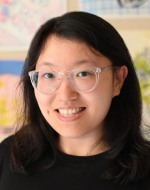
Assistant Professor Lucy Li joins the Department of Computer Sciences, with an affiliate appointment to the Information School, after a postdoc at the University of Washington’s Allen School in Seattle. Her path to natural language processing began with a book about the language of food and a Tumblr project analyzing the final messages people send at the end of friendships and relationships. Li now studies human-AI interaction and the ways AI is reshaping society, from education to fairness. Li has already checked a good number of State Street food carts off her list, and, she says she has a great starting cohort for her research group.
Tell me a bit about your personal and professional background.
I’m from Woodbury, Minnesota, so I lived about 15 minutes from Wisconsin, just across the St. Croix River from Hudson. I went to Stanford for undergrad and my master’s, then Berkeley for my PhD, and then did a postdoc at the Allen School in Seattle. So I circled back in the end.
How did you get into your field?
I’ve always been a data-oriented person. I like looking at things at scale. As an undergrad I picked up a book called The Language of Food by Dan Jurafsky. One chapter showed how you can analyze restaurant menus to see how restaurants present themselves, like a French restaurant versus a fast-food place. I thought it was fascinating that language is a lens into human behavior and you can analyze it at scale with computers.
I had Dan sign the book, and later I ended up collaborating with him on a research project, and he was on my dissertation committee. Things went from me reading one book to taking his class to entering his field.
Was there an early project that hooked you?
For a writing class, I analyzed a Tumblr that posted screenshots of people’s last messages to each other, at the end of friendships and breakups or when someone passed away. This was before AI transcription, so I typed them all into a spreadsheet by hand. What stood out was that people almost never said “goodbye.” The most common word was “sorry.” That hit deep. It was simple word counting, but I like to immerse myself in data, and that spirit has stayed with me.
What problem are you trying to solve?
Mostly, how AI is affecting society. For example, in education, AI is optimized to be good at math, but being an expert doesn’t mean you can spot errors in a novice’s work. AI is also optimized to be helpful, but a good teacher knows when to withhold help and push a student. I want to know whether AI can support learning rather than erode critical thinking.
I also work on fairness. I have a paper coming out this month showing that audio language models are biased against people who don’t speak American English, like many of our international students.
Even if AI becomes superintelligent, humans will still be quirky and interesting, and the challenges of working with AI will still be there.
How would you explain the relevance of your work to non-computer scientists?
Because my work is so human-centered, it’s a little evergreen. Even if AI becomes superintelligent, humans will still be quirky and interesting, and the challenges of working with AI will still be there.
What do you hope students take away from your classes?
I’m teaching Advanced NLP this semester. I want students to understand that the decisions behind these models aren’t arbitrary, so even if the transformer (a type of moder architecure for processing sequences of data) evolves into something else, they’ll have the critical thinking to handle it. AI changes so fast that what I teach this year may be outdated next year. We don’t need to memorize how each and every new method works, just what problems they try to solve.
I also want students from outside computer science to feel NLP is open to them, so I’ve been thinking a lot about how to make the transformer and important equations look visually accessible.
What have you done in Madison so far?
I’d only been to Wisconsin once before, to the Dells when I was seven, so my first real visit was my job talk. Since then I’ve gone back to the Dells (I made a visiting professor go down athe vertical waterslide), biked around Lake Monona, and gone to a pumpkin patch. I’m also checking off a list of top food carts. Next up: Chicago, Milwaukee, and a second cat.
How does being a professor compare to being a PhD student?
It’s so much more fun. I have a sense of responsibility, and it makes me feel accountable and purposeful. I have three PhD students, and they’re great. I told them that a PhD is a collaborative, community-centered effort; their biggest defense against marathon of doing a PhD is each other.