CS students celebrate #CSEdWeek at afterschool coding clubs across Madison
This week (Dec. 18-14) marks Computer Science Education Week (#CSEdWeek) in Wisconsin and across the U.S. Here in Madison, the 4th and 5th-grade members of Randall Elementary School’s “Scratch Club,” an afterschool coding club facilitated by UW–Madison Computer Sciences (CS) students, celebrated with an end-of-semester presentation for parents — and the Channel 15 News.
Randall’s Scratch Club is one of around ten across Madison, says Instructional Administrator Peter Kirschmann, who teaches CS 402 (Introducing Computer Science to K-12). His two-credit course guides undergrads as they learn to lead the clubs (with crucial support from community partners and parent volunteers). “CS 402 is a great course for undergraduate and graduate students who want to develop communication, leadership, and collaboration skills,” says Kirschmann. “UW–Madison student facilitators create opportunities for elementary students to learn computer science concepts and use those skills to make creative, personal projects.” At Randall, UW–Madison CS sophomores Saurabh Abhyankar, Rory Shore, and Stephen Shoucair spent the fall 2025 semester working alongside (now former) volunteer coordinator Lisa Grueneberg ‘93, an alumna of UW–Madison Computer Sciences and a retired Epic software developer. December 10 marked Grueneberg’s final Scratch Club after eight years as Randall’s site coordinator — though before the meeting even started she’d already affirmed plans for future (perhaps less hands-on) involvement with Randall’s Scratch Club. “Things have changed over the years. The kids know a lot more about programming when they come to my club than they used to,” Grueneberg told Channel 15’s Shaina Nijhawan. Interest has also grown across genders, Grueneberg noted. “It’s almost 50-50 girls and boys being interested in it. Which warms my heart, because I’m a woman in computer science and at this age, they’re equally as interested and equally adept, of course.” Thank you to the students, staff, volunteers, alumni, and parents who make programs like UW–Madison’s Scratch Clubs possible. Learn more about enrolling in CS 402 or inquire about establishing a Scratch Club at your school.Photo Recap: #CSEdWeek 2025 at Randall Elementary School

Members of the Randall Elementary Scratch Club present their end-of-semester projects to parents at the final club meeting of the year on Wednesday, December 10.

Volunteer coordinator Lisa Grueneberg ’93 (left), a UW–Madison Computer Sciences alumna, has managed the Scratch Club at Randall Elementary for eight years.

Peter Kirschmann (far right) is the instructional administrator who manages all ten Scratch Clubs across Madison.

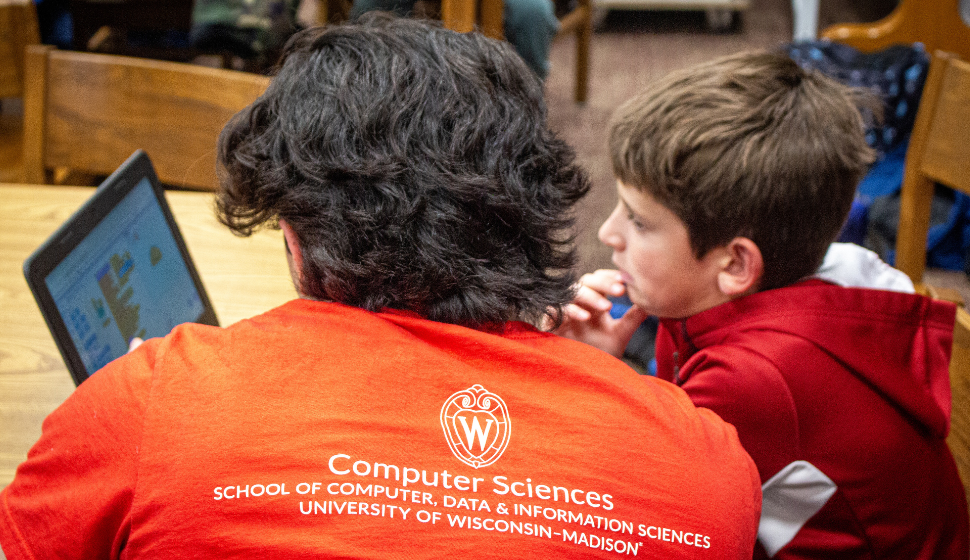
Students hang out after school and learn Scratch, a block-based visual programming language and educational tool developed by MIT.

The drag-and-drop system used in Scratch allows students to test code instantly. The students use these beginner-friendly coding tools to build simple games and animations.

UW–Madison students like Saurabh Abhyankar (top right) help facilitate Scratch Clubs in elementary schools across Madison as part of CS 402 (Introducing Computer Science to K-12 Students).

For some of the elementary school students, it’s the first opportunity to explore computer science and coding.

The club is hosted in Randall’s library, where students work independently and jointly on projects.

Randall’s Scratch Club is a lively and creative space for students to explore their interests, whatever they may be — this semester, students created games revolving around exploding pickles, Sprite, and “99 Nights in the Forest,” a popular action survival game.

They also receive welcome guidance from parent volunteers like Ben Stein.

At the end of the semester, students are thrilled to show off their final projects and new coding skills.