Teaching Professor Debra Deppeler retires after 25 years
Deb taught nearly 15,000 students one core lesson over 25 years: understanding is always worth the work, and mistakes are how you get there.

After more than two decades in the classroom, Teaching Professor Debra Deppeler is retiring from the Department of Computer Sciences, leaving behind a legacy measured not just in years but in students. Deb earned an MS at UW–Madison in Computer Sciences in 2000 and joined the department in 2001. In her 25 years with the department, Deb has taught a staggering 15,000 undergraduates.
For Deb, teaching has never been about delivering answers. It has been about helping students learn how to think.
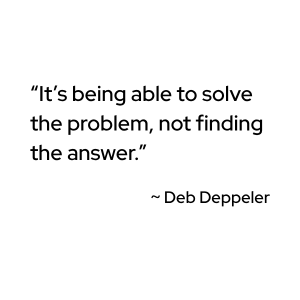
“It’s the work that matters,” she says. “That’s the part that’s going to stick with you. It’s being able to solve the problem, not finding the answer.”
That philosophy is rooted in her own academic journey. Deb describes her path as “a scenic route” — one that began in forestry, included time in the workforce and the Peace Corps, and eventually led her back to UW–Madison to study computer science. Along the way, she learned firsthand what it means to struggle, adapt, and persist. The UW–Madison Women’s Rowing Team played a large part in her return to academics: “I would not know nearly as much about work and teamwork and may not have returned to complete my bachelor’s degree if I hadn’t wanted to keep rowing,” she says.
“I try to parlay my own academic challenges into support and empathy for students who need extra help along the way,” she said when she was appointed a Teaching Professor. “The best is when I finally convince a student that it’s okay to read the textbook without fully understanding it, because it turns out that means you’re in the right place.”
Teaching at scale — and with intention
When Deb first began teaching as a graduate student in 1998, her classes were small — just a couple dozen students per section. Over time, as computer science enrollments surged, her classrooms grew dramatically, bringing new challenges along with new opportunities.
Even as class sizes expanded, Deb remained committed to making learning active and personal. She encouraged students to engage deeply with material, work collaboratively, and embrace mistakes as part of the process.
“The only things I ever remember are the things I figured out,” she says. “When you make a mistake,” she says to her students, “I think it’s good. Now you can learn something today.”
Her teaching approach emphasized effort over ease and persistence over perfection. She pushed students to move beyond simply arriving at correct answers, especially in an era when answers are increasingly easy to access. Instead, she asks students to focus on understanding the underlying concepts.
During her 25 years in the classroom, Deb continually adapted teaching approaches as technology and student needs evolved, always with the same goal of helping students genuinely understand the material. When she creates tests for her students, her goal is to “know what [they] know,” she says. “And I want to know that the scores I have for [them] reflect that [they’ve] learned something.”
A Lasting Impact
Across her career, Deb has been a steady presence through periods of significant change in the department, from rapid enrollment growth to evolving teaching technologies and ongoing efforts to broaden participation in computing.
While she notes that challenges remain, particularly in creating a more inclusive field, her focus has always been on what she can do in her own classroom: building connections, encouraging collaboration, and helping students see themselves as capable learners.
Her favorite moments have often come outside of lectures: in conversations during office hours, in problem-solving sessions, and in the gradual confidence students build over time.
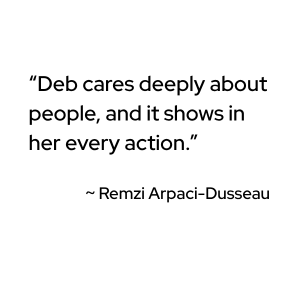
Remzi Arpaci-Dusseau, Computer Sciences professor and Founding Dean of the College of Computing and Artificial Intelligence, reflects on Deb’s career: “I first met Deb in the first class I ever taught at UW,” he says. “Even then, I could tell she was a natural teacher: curious, thoughtful, and always with a knack to explain. But above all of that, she is kind: Deb cares deeply about people, and it shows in her every action. She has selflessly served thousands of students over her career with us and will be greatly missed.”
“I like talking to students,” Deb says. “I just don’t enjoy assessing their learning . . . I want to get someplace where I don’t have to assess the learning, where I get to just help them.”
That desire to keep helping others learn will continue into retirement. Deb plans to stay active through tutoring middle-school and high-school students in math, teaching new drivers, and pursuing long-standing interests, from woodworking to long-distance cycling.
But even as she looks ahead, her impact on UW–Madison is already firmly established in the thousands of students she has taught, mentored, and encouraged along the way.
For many of them, her lessons will extend far beyond the classroom: that learning takes effort, that mistakes are part of the process, and that understanding is always worth the work.