Expressive Machina: Designing curious, joyful robots
Words and photos by Rachel Robey
Amy Koike PhDx’27 explores how thoughtful robot design can invite human interaction — maybe even friendship.
 Most robots are designed to perform practical, if relatively unglamorous, functions: repetitive manufacturing tasks, unsanitary jobs like cleaning and maintaining sewers, or risky mining and exploration activities. These “three D’s” of robotics — dull, dirty, and dangerous — guide the development of most robots.
But not all of them.
Amy Koike, a PhD candidate researching human-robot interaction in the People & Robots Lab, doesn’t design robots that promote human efficiency. Full of personality, their primary function is to spark human connection — and joy.
In her own words, Koike’s robots are one part engineering and one part performance art. Yes, they have practical applications, but they have something else on top of that: the ability to express themselves. In fact, they couldn’t do their “jobs” without it.
“Performative expression”
Directed by Professor Bilge Mutlu, researchers in the People & Robots Lab investigate the possibilities and perceptions of robotics from a human-centered perspective. Koike is particularly interested in building robots that “blend seamlessly into society … provide better services, and, of course, [are] loved.” Much of the inspiration for her robots comes from her fascination with art and graphic design, as well as characters from anime, manga, and animation. Walt Disney Animation Studios regularly creates beloved 2D characters that come alive for people; Koike does the same in 3D.
Most robots are designed to perform practical, if relatively unglamorous, functions: repetitive manufacturing tasks, unsanitary jobs like cleaning and maintaining sewers, or risky mining and exploration activities. These “three D’s” of robotics — dull, dirty, and dangerous — guide the development of most robots.
But not all of them.
Amy Koike, a PhD candidate researching human-robot interaction in the People & Robots Lab, doesn’t design robots that promote human efficiency. Full of personality, their primary function is to spark human connection — and joy.
In her own words, Koike’s robots are one part engineering and one part performance art. Yes, they have practical applications, but they have something else on top of that: the ability to express themselves. In fact, they couldn’t do their “jobs” without it.
“Performative expression”
Directed by Professor Bilge Mutlu, researchers in the People & Robots Lab investigate the possibilities and perceptions of robotics from a human-centered perspective. Koike is particularly interested in building robots that “blend seamlessly into society … provide better services, and, of course, [are] loved.” Much of the inspiration for her robots comes from her fascination with art and graphic design, as well as characters from anime, manga, and animation. Walt Disney Animation Studios regularly creates beloved 2D characters that come alive for people; Koike does the same in 3D.
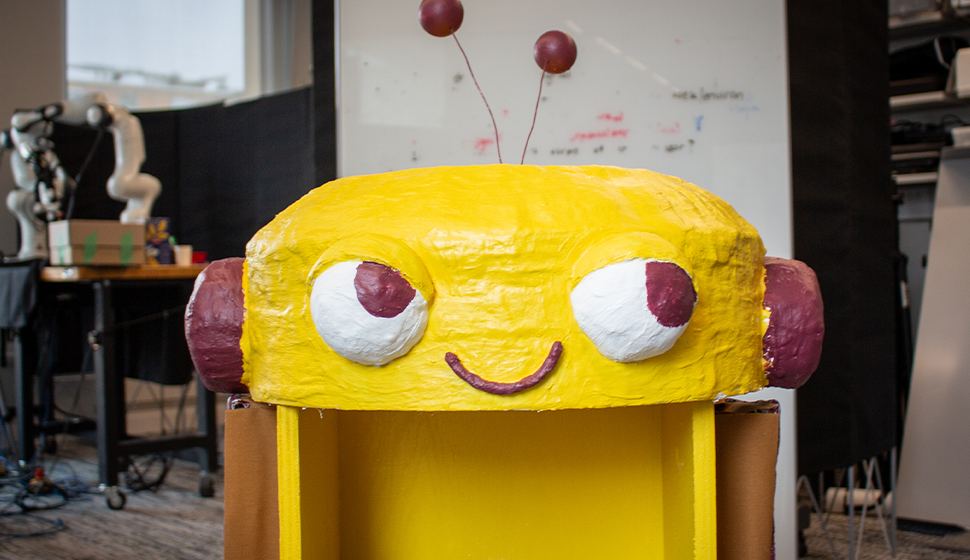 “I’m not sure if it’s an ‘appropriate’ motivation as a researcher, but I want to make people happy. I want to make them smile,” she says. Her pioneering work focuses on how physical design enables robots to act out social cues — essentially, to emote. She calls this “performative expression” and argues that it enhances human experience with robots.
 To achieve these (seemingly) emotionally intelligent bots, Koike borrows graphical tropes from animation, comics, and video games — like steam coming out of a character’s ears to indicate frustration — to lend her robots a kind of nonverbal language.
The result: Instead of cold, rigid, and impersonal, Koike’s robots are friendly and cute — even charismatic. In 2024, her robot Sprout took home Best Paper (Design) at the International Conference on Human-Robot Interaction. An inquisitive desktop-sized robot you might expect to see in a Pixar film, Sprout contorts its flexible silicone body to convey internal meanings like anger, curiosity, or surprise — just like humans do.
One day, Koike hopes to deploy these socially minded robots in settings where they can actually help. Perhaps in a museum where they can share exhibit information or directions, or in a waiting room where they might provide positive distraction for otherwise unruly children.
To achieve these (seemingly) emotionally intelligent bots, Koike borrows graphical tropes from animation, comics, and video games — like steam coming out of a character’s ears to indicate frustration — to lend her robots a kind of nonverbal language.
The result: Instead of cold, rigid, and impersonal, Koike’s robots are friendly and cute — even charismatic. In 2024, her robot Sprout took home Best Paper (Design) at the International Conference on Human-Robot Interaction. An inquisitive desktop-sized robot you might expect to see in a Pixar film, Sprout contorts its flexible silicone body to convey internal meanings like anger, curiosity, or surprise — just like humans do.
One day, Koike hopes to deploy these socially minded robots in settings where they can actually help. Perhaps in a museum where they can share exhibit information or directions, or in a waiting room where they might provide positive distraction for otherwise unruly children.
 Build-a-bot
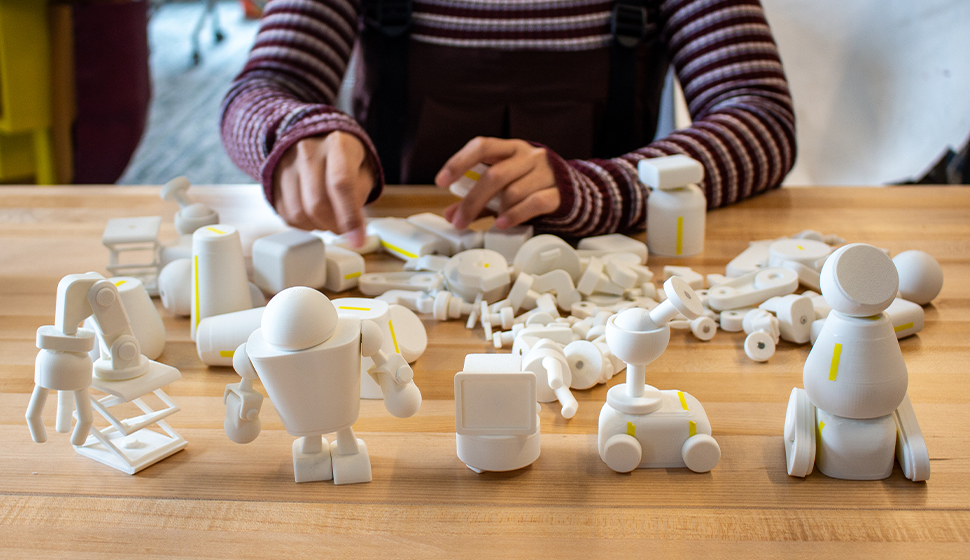
Beyond the physical engineering of her robot companions, Koike’s research follows another theme: the development of a formal design method other roboticists can borrow. Motivated by a desire to understand how robot morphology, or shape, alters human interaction, Koike developed a physical handbook of robotic design elements. The blocks operate like Legos, allowing users to imagine and build countless distinct robots.
“There are standard elements of graphic design, like line, shape, and color. I wanted to develop a robot version of that,” Koike explains. “After analyzing existing robot morphologies, I deconstructed each component into 3D-printed blocks that designers can use to explore robotic form.”
Build-a-bot
Beyond the physical engineering of her robot companions, Koike’s research follows another theme: the development of a formal design method other roboticists can borrow. Motivated by a desire to understand how robot morphology, or shape, alters human interaction, Koike developed a physical handbook of robotic design elements. The blocks operate like Legos, allowing users to imagine and build countless distinct robots.
“There are standard elements of graphic design, like line, shape, and color. I wanted to develop a robot version of that,” Koike explains. “After analyzing existing robot morphologies, I deconstructed each component into 3D-printed blocks that designers can use to explore robotic form.”
 Animators and illustrators already rely on an instinctive and unspoken “shape language” to subconsciously communicate a character’s values, identity, or other aspects. Consider the bouba/kiki effect: Circular characters are felt to be soft and peaceful, while angular shapes are sharp and dangerous. Koike’s style guide and 3D blocks translate these principles to robotics so other designers can build robots that aren’t just functional — they have personality, too.
“I’m interested in how I can stimulate people’s imagination,” Koike explains. “I don’t want my robots replacing human workers. Rather, I want them to be companions that make our lives happier, more joyful.”
Animators and illustrators already rely on an instinctive and unspoken “shape language” to subconsciously communicate a character’s values, identity, or other aspects. Consider the bouba/kiki effect: Circular characters are felt to be soft and peaceful, while angular shapes are sharp and dangerous. Koike’s style guide and 3D blocks translate these principles to robotics so other designers can build robots that aren’t just functional — they have personality, too.
“I’m interested in how I can stimulate people’s imagination,” Koike explains. “I don’t want my robots replacing human workers. Rather, I want them to be companions that make our lives happier, more joyful.”
This is the second installment in a series highlighting robotics research in UW–Madison Computer Sciences. Check out part one featuring a robot soccer team programmed to “bend it like Bucky.”
Koike, surrounded by her robot designs, in the People & Robots Lab.
Inspired by the memory of sweet potatoes made by her grandmother, Koike’s robot “Oimo-don” was designed to feed people experiencing hunger. (Oimo (おいも) means potatoes, and don (どん) is a diminutive suffix with affectionate connotations.)
Sprout relies on fiber-embedded actuators to extend, bend, twist, or expand.
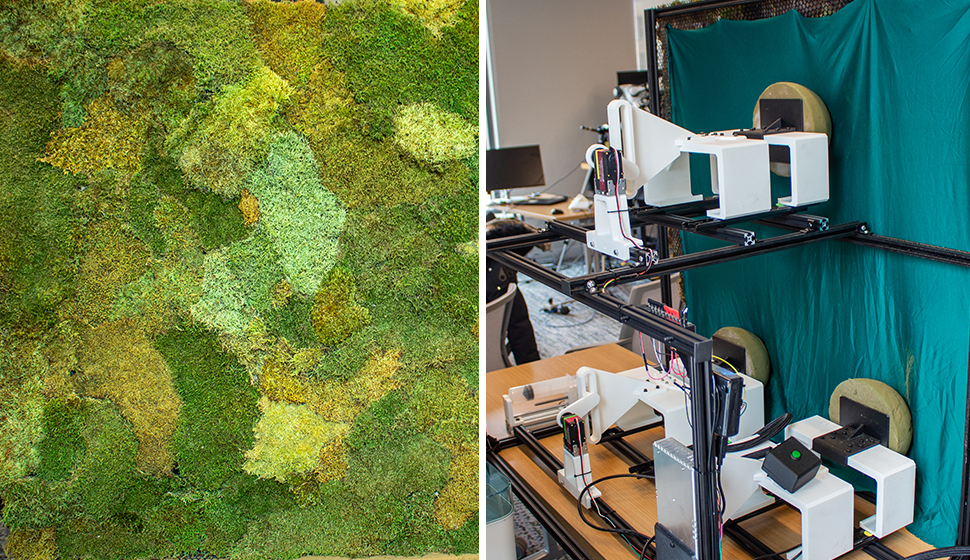
Left: Koike developed “Nature in Motion,” a robotic moss sculpture, in collaboration with Rachael Shields PhDx’27. Right: The mechanics that allow “Nature in Motion” to inhale/exhale.
Koike demonstrates the use of 3D-printed blocks to explore different robot morphologies.
This is the second installment in a series highlighting robotics research in UW–Madison Computer Sciences. Check out part one featuring a robot soccer team programmed to “bend it like Bucky.”